State of Belief
Rev. James Martin On His Journey to Becoming a Priest, and the Catholic Church Today

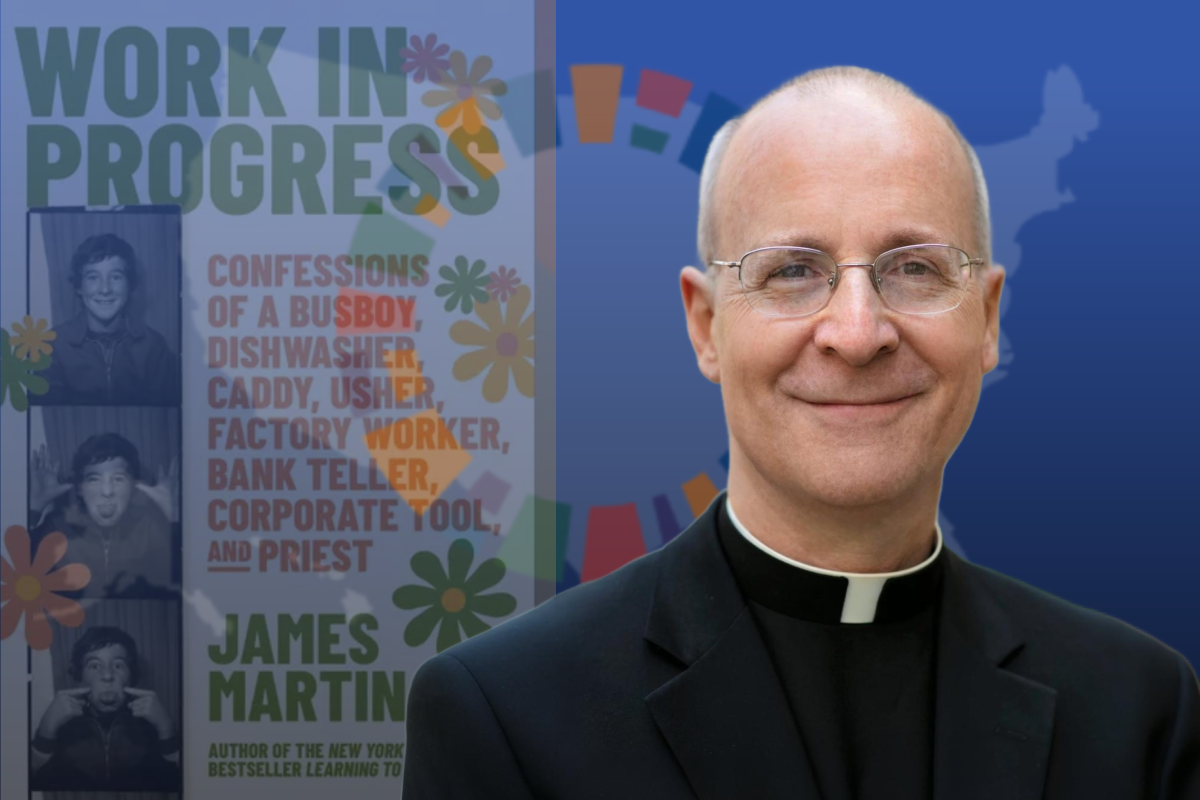
Father Jim Martin’s new memoir, Work in Progress: Confessions of a Bus Boy, Dishwasher, Caddy, Usher, Factory Worker, Bank Teller, Corporate Tool, and Priest, includes plenty of funny stories that are also deeply human, full of honesty and hope. Jim’s always a wonderful guest, and this week he joins host Rev. Paul Brandeis Raushenbush to walk us through some of the memorable moments in this book.
The book opens with stories of summer jobs ranging from dishwasher to factory worker, all while weaving in the idea that God works even in the most mundane places. This is an invaluable reminder that we’re all on a spiritual journey, whether we realize it or not. And the path to faith isn’t a straight line. It’s messy, ongoing, and filled with grace. Honesty is what makes his memoir resonate. It invites us to reflect: where are we still "works in progress"?
Father Jim also takes us through the tumultuous history of America—recalling moments like the Bicentennial, the moon landing, and the Nixon resignation—and connects it to our current time. We’re living in a moment that will surely be remembered as monumental, and Jim’s reflections on truth, history, and the ways we forget or erase it feel especially urgent. Lies and nostalgia can be dangerous when they hide the real stories, especially the stories of marginalized communities.
What’s powerful is how Jim emphasizes that the gospel isn’t about nostalgia or idealized versions of the past; it’s about standing with those on the margins—migrants, refugees, LGBTQ+ folks, and others dehumanized and pushed aside. His stories about engaging with those communities—meeting Pope Francis, speaking at protests, standing with migrants—are inspiring. They’re a reminder that courage isn’t absence of fear but standing with others when it’s hard.
Our lives, our nation, and our faith are all ongoing works. We’re never finished, and that’s the point. Father Jim Martin's reflection on his own moments of reckless youth, and how those stories led him closer to a calling, offers hope to anyone feeling like their journey is incomplete.
More About Father Jim
Rev. James Martin is a Jesuit priest, editor-at-large of American Magazine, consultor to the Vatican Secretariat for Communications, and the bestselling author of books including Jesus: A Pilgrimage and The Jesuit Guide to Almost Everything. His book Building a Bridge: How the Catholic Church and the LGBT Community Can Enter into Relationship of Respect, Compassion, and Sensitivity had a profound impact on many readers on either side of that divide. Father Martin has a new book out, Work in Progress: Confessions of a Bus Boy, Dishwasher, Caddy, Usher, Factory Worker, Bank Teller, Corporate Tool, and Priest.
Transcript
REV. PAUL BRANDEIS RAUSHENBUSH, HOST:
Rev. James Martin is a Jesuit priest, editor-at-large of America Magazine, consultor to the Vatican Secretariat for Communications, and the bestselling author of books including Jesus: A Pilgrimage and The Jesuit Guide to Almost Everything. His book Building a Bridge: How the Catholic Church and the LGBT Community Can Enter into A Relationship of Respect, Compassion, and Sensitivity had a profound impact on many readers on either side of that divide. Father Martin has a new book out, Work in Progress: Confessions of a Bus Boy, Dishwasher, Caddy, Usher, Factory Worker, Bank Teller, Corporate Tool, and Priest, A Funny, Wise, and Inspiring Spiritual Memoir.
My God, I'm so excited to talk to Father Martin about this book and so much else that's happening in our world today. Brother Jim, welcome back to The State of Belief.
REV. JIM MARTIN, GUEST:
Thanks, my friend. It's always good to talk to you. I love talking with you. And thanks for having me on your podcast and your show.
PAUL RAUSHEBUSH:
Well, first of all, congratulations on this book. I mean, I have to say, the moment I saw the title, I was like, this is going to be really good and really funny. And I just want to start with something that you say right in the beginning of the book - which I really loved - which is you said, everybody's life is a spiritual journey, whether they know it or not. And I think naming that, I think that's a really foundational idea, I feel that as a pastor as well.
You don't have to be religious and you don't have to talk about it in religious terms, but you're alive and you are on a journey. And actually taking the time to think about that as, not goalposts, but posts along the way. I think it's really beautiful to name that for your readers who are reading someone they admire and think of as, like, he's the spiritual guy and I'm just the reader. But rather, instead, inviting them into, perhaps ultimately, a reflection on their own life.
JIM MARTIN:
Thanks for pointing that out. And one of the points of the book - a lot of the book is retelling of some funny summer job stories, those crazy jobs that you listed in the subtitle - is that God is at work even in a busboy, you know, a podcaster like you, a pastor, a mother, an attorney - even a Jesuit priest. And I think it's only in looking back on our lives that we can see, really, God's hand in all of this. And it was writing this book about these crazy summer jobs and my work at GE and then entering the Jesuits, that I could really see a lot of grace – really, a lot of grace, and a lot of learning going on. So you're right, I think the key is inviting people to know that they're on a spiritual journey, as you know.
PAUL RAUSHEBUSH:
And I love that we're looking for the punchline. When is he going to feel called? And that's when the real stuff starts - but that's actually just part of it. And the other thing - we're talking about the book now - you know, I love talking to you, brother Jim. So there's lots of things I want to talk about, including the state of our country. But right now I just am launching into this book and really talking about why you really went deep into all of these different moments, and that you said something like, I don't regret any of it.
I feel that way. I had a period of drug abuse and drinking and people are like, I'm sorry, and then you got beyond it. And I'm like, I'm not sorry. I learned so much. I was interacting with so many in a particular way in a particular time. And I learned about grace, as you said. So nothing is lost if you decide to look at your life that way.
JIM MARTIN:
That's a beautiful way of saying it - nothing is lost. And also, I forgive myself for peccadilloes and extravagances and debauched nights. I talk about one or two in the book. I was 17 years old. I didn't kill anybody, didn't rob any banks - actually worked at a bank. I wasn't mean. But I think to not include those things, to not include the times that I was drinking and getting high and also not being charitable and being selfish and being self-centered would have been dishonest.
I find, and I'm sure you do as well, that the kinds of spiritual memoirs that I like, the best are the ones where the writer, whether it's Thomas Merton or Henry Nowen or Kathleen Norris or Augustine, is honest about their background. And it's also not, like I say in the book, I rue all that and I regret all that and then I became a Jesuit priest. No, it led me to where I am, and that's part of these stories and these crazy summer jobs and other work that I did is part of who I am. It formed me, as we say, in the Jesuits.
PAUL RAUSHEBUSH:
You're right. Well, you said you didn't kill anybody, but there's an interesting moment when you killed the Pope.
JIM MARTIN:
Yeah, that's a crazy story.
PAUL RAUSHEBUSH:
You have to tell that story, because I was reading that one, it's just a funny idea that you would kill the Pope. But tell the story and then we can talk about it.
JIM MARTIN:
Spoiler alert, I did not kill the Pope.
PAUL RAUSHEBUSH:
But the headline of this entire podcast is, how I killed the Pope.
JIM MARTIN:
Please do not do that. That's all I need. So I was an undergraduate at the University of Pennsylvania in 1978 in September. I'm a freshman. And John Paul I had just been elected, Albino Luciani. I go out with friends of mine who aren't Catholic. And so I started to tell all these Jesus jokes, which I am a little embarrassed about that, and they are pretty awful. And we came back to my freshman dorm, to our freshman dorm.
And someone said, Martin, the Pope is dead. And I said, no, he died a month ago. And he said, no, the new one. And I said, what? And we turned on the radio and my friend Andy, who I'm still in touch with, said, you were saying all those Jesus jokes, and now he's dead, you killed him. And I actually felt pretty bad. And I woke up the next morning - we were all drunk - I woke up the next morning and everybody was asking me, yeah, I heard you killed the Pope. And so that continued regularly for the rest of my life.
When I entered the Jesuits, the first thing Andy said was, do they know you killed the Pope? And then when I was ordained, when I took my final vows, and funny enough, when I first met Pope Francis, I actually met a real Pope, Andy texted me and of course, what did he say? Did you tell him that you killed the other guy? So our friends, one of the reasons I tell the story is because it's a little crazy and funny. I did not, in fact, kill the Pope. And it also sort of tells the reader that my friends do not let me take myself too seriously.
PAUL RAUSHEBUSH:
Well, all of this goes into the name of the book, which is Work in Progress: and then confessions of a bunch of things that ends in “Priest”. But what I like about that title is that it's not a finite idea. You're not like, I've arrived, I attained, I became a priest and now I'm perfect. And I think that that's really also an important idea, is that work in progress really means work in progress - that we, hopefully, are never done. And so I want to acknowledge that that's part of the sense of this great book, Work in Progress by Jim Martin, is that it's an invitation to imagine our lives as continuing; that we're not done. No one is done until you're dead. And so the idea is, even at later stages of life, we can still be works in progress.
JIM MARTIN:
Totally. Thank you for noticing that. I'm really big on titles; the title has three layers. First, it is me, the author, as a work in progress. Second, it is the reader, who is also a work in progress. We're all works in progress. And third, it's kind of a strict telling of what's going on in the book. It is a progression of work. I mean, I'm going from one work, one job, to another. So these are work in progress.
I really hope that what people take away, one of the interesting things, Paul, as you know, from doing book talks and whatnot, is you always get something different than you have expected from a book. And one of the things that people have been sharing with me, which I think is really beautiful, is - and I didn't expect this - is it's calling up all these old memories that people have had on their own of, for example, summer jobs and their parents and growing up.
And they share with me these things: My gosh, I was a waiter once and this thing happened and you know, my parents did this with me and encouraged me to work and it's been really beautiful. And that's sort of the point of the book was to get people to think about their own lives. But I guess I've been surprised how many people share with me their summer jobs and what those summer jobs meant to them. And I'm kind of curious, which ones were meaningful to you in your own life?
PAUL RAUSHEBUSH:
My summer jobs included things like being a chore boy. I would do anything for hire. I would mow a lawn like you did. I would weed. was a lifeguard for a little bit.
The other thing that I think is interesting about the book is it takes us along a history of America. There's moments, you start at the Bicentennial, which I remember very well as well, and what that meant and how it's both exciting and incredibly mundane at the same time, and you're like, what are we really doing here? And all the way through, it's also a history of America.
And I remember when Brad, my husband, wrote a book about Flannery O'Connor, my dad, who was not a big Flannery O'Connor fan, said, I really liked reading about the time that was covered during her life, because it was such a monumental time. And I think there's also that idea of, well, how do we remember the time we've lived through? And so I think that's also really important, because right now we're living in a monumental time. And we have to remember history continues.
JIM MARTIN:
Thanks for noticing that. I tried to do a little bit of a cultural history, too. So there are historical moments, the bicentennial, I talk about the moon landing, I talk about Richard Nixon resigning, these are all big things in the 70s, the oil crisis, all this kind of stuff. Ronald Reagan, Reaganomics, the yuppies, all that. I also wanted it to be, as much as it could be, kind of a cultural history of what family life was like then, at least for White middle class families in Plymouth Meeting, Pennsylvania. What school was like for me, because it's a little bit of a vanished time.
It wasn't perfect. It wasn't this sort of Halcyon idyll, but at one point in the book I talked about all the things that kids could do that they don't do now. And one of them was walking to school at the age four to kindergarten. And I say in the book that I had this memory, and I asked my mom, I said, could that be true? And she said, of course! She said, I took you to school - you'll love this - I took you to school the first few times at four and then I figured you knew the way. And I asked my - and I know you have kids as well - I asked my sister, I said, what would happen today if some parent, sent their four-year-old out to walk to school for two miles? And Carolyn, my sister, she said, you'd probably be arrested.
PAUL RAUSHEBUSH:
You would be arrested, 100%. For sure. A lot of the things - and I live in the City, so, one of the very different things is just my kids’ inability to open a door on their own, at this point, even their own door.
Bringing up cultural history and the history of America makes me think of: you went to college at Wharton, at the University of Pennsylvania. We have another person, very well known - maybe a little better known than you, I hate to say that, but it's possible, in a different way - which is our president. When we talk about our history as two kind of very young-looking White guys of a certain age, has made an entire movement out of this kind of nostalgia and make America great again.
I want to talk a little bit about how you understand this moment in America, as someone who has gone through this progression. And especially as someone who felt called to the priesthood, and what that means to you right now, in this moment, having come up through America and arriving now. So I'm sorry to kind of take a turn, but it feels important to recognize that we are in another moment in history.
JIM MARTIN:
Well, I really like the way you framed that question and I see two things going on. One, as you were saying, there is this sort of reach for this nostalgic past that I don't know ever really existed. And if it did exist, say in the 1950s and 1960s when I was alive, it didn't exist for everyone. If you were a person of color, if you were LGBTQ, if you were poor - I mean, you can look back on Ozzie and Harriet and the Brady Bunch and all that, and maybe for middle-class White people like myself it was a halcyon time, but not for everyone. I think that's the first thing.
But the other thing, Paul: as you were talking I was thinking, just recently there's been an erasure of history, as well. Two of the things that I find most shocking - I mean truly - I would say that this administration has shocked me in many ways, and you know I don't like to get too political, but I can say this: the removal of the of the plaques around Independence Hall in my hometown in Philadelphia detailing George Washington's owning of enslaved people, which is history. It's history. And I thought that was a great step forward. And I know in Philadelphia, as a Philadelphian, that people were very, very attentive to that and really took a lot of care with that because it's a shrine, it's a national shrine, and it was very sensitively done. The removal of those plaques.
And then, even more recently, the removal of the flag from Stonewall constitutes not only a sort of deification of a nostalgia that didn't really exist, but an erasure of history that did exist. And so, I was just thinking last night that, in a sense, it's also anti-Christian. Why do I say that? Because Jesus says the truth sets us free. And if we are going against the truth, then we are acting against that impulse from Jesus. Jesus is the way, the truth, and the life. I really think we have to connect those things; and to put forth, in a sense, a false version of history, is to put forth lies, is to go against what Jesus asks us to do, which is live in truth.
PAUL RAUSHEBUSH:
Those two examples absolutely shocked me. And then it goes on: if you look at the way that books are taken off shelves that have Black characters, have LGBTQ characters, but also that have Jewish characters or Muslim characters or Sikh, is really the effort to control the narrative. And really, I think it's rooted in this idea we're a White Christian nation, anything that makes that uncomfortable - and by the way, maybe they consider Catholics a part of this, but not always. If we think about the past, Catholics were not - sorry to put you on the spot here, but really, it's a Protestant ideal. And a lot of Catholic nations had their quotas restricted, of immigration. This is another part of our history that we're seeing, right now, either intentional amnesia - and that's part of the reason I'm connecting this to your memoir, because it's really important to tell the story and tell all the stories.
JIM MARTIN:
Well, and there's a dehumanization of people going on, as you know. People are called animals and vermin. And we see this in Nazi Germany with the Jews. We see it in Rwanda, you know, between the Hutu and the Tutsis. We saw it during World War II with the Japanese. And so there is this move towards dehumanizing people so that then you can mistreat them.
And currently, I think the people that are being most dehumanized would be migrants and refugees and particularly transgender people. This kind of attack on them and it makes it easier for people to ignore them, to reject them and even to do violence against them. Part of my book is also that both of my parents are children of immigrants. My mom's parents came right over from Sicily.
I think the other thing, Paul, that just shocks me, really shocks me, is unless you are a Native American, you are the child of immigrants. And you could even say a distinguished family – I know you come from a very distinguished family - even if your forebears came over in the Mayflower you're an immigrant.
PAUL RAUSHEBUSH:
Let's add people who came against their will. I know you mean that, as well, but yeah, 100%. And by the way, when my ancestors came over, there was no Ellis Island. They just came over, so this idea we can't have free borders - well, actually, we did at one point.
I do think you're naming something that we just have to keep on naming is that if you call people, if you dehumanize them, it allows things to be done to them. And that is the history of terrible atrocities in this country, as well as in Nazi Germany and other places. And, you know, it's just an important fact that the week before ICE went to Minneapolis, Donald Trump at a televised cabinet meeting called Somali-Americans garbage.
JIM MARTIN:
And let me tell you, having worked with Somali refugees for two years in East Africa, I was shocked. The Somalis that I knew in Nairobi were among the hardest working people that you could imagine. So I think there's two things going on. It's interesting. I always love talking to you. It helps me clarify what I'm thinking. There are two things going on. One, you have a nation of immigrants and people who have been, as you say, brought here against their will, some of whom are saying that we don't want immigrants or that's not who we are.
And then you also have a nation that includes many Christians who are going against the gospels where Jesus says you should welcome the stranger. So there is this kind of willful ignorance of what we are as Americans and what many of us are as Christians. And truly, I really don't understand how people can really sort of square those things.
I know there are lots of excuses, I know that Speaker Mike Johnson – again, I don't like getting political, but speaker Mike Johnson talked about Romans 13, about following civil authorities. And I don't have to tell you, you know more scripture than I do, but I thought there was a wonderful response from some of the bishops who pointed out: not only Jesus’ call to welcome the stranger, but that Romans 13 - that that is not an absolute. I mean, if it were an absolute then you could say that all the Germans should have obeyed Hitler. So it really is this kind of willful and willed ignorance, I think, that we really have to confront as much as we can.
PAUL RAUSHEBUSH:
I think it's really important to name the way, frankly, that the Catholic Church has stood up in this moment. And I think, you know, it's something to really claim. I hope you feel gratified by it. know those of us who are out there in the streets, it means something when cardinals are saying no, when Pope Leo himself is saying no. And I know the Catholic Church tries to, you know, it is both in the world and above the world. But I think it's really been important. And I'm with a lot of people who are trying to do good work in this moment. When someone like Cardinal Cupich shows up to a big webinar and speaks, it actually means a lot. And right now, one of the things I like to talk about is Christians are showing up, and Americans in general are so hopeful and hungry for Christians to actually show up like Christians right now.
JIM MARTIN:
Yeah, and to speak about the Gospels. And one of the great things is for people who might be listening and say, oh, that's too political - they're preaching the Gospel, which is being with the stranger. And the Catholic Church in the United States, in particular, I have to say, it's not perfect. The US Conference of Catholic Bishops is not perfect. Not every bishop is perfect. But they have been great on this in standing with migrants and refugees. And we have to ask ourself, as Pope Leo and Pope Francis before him, and frankly, Benedict and John Paul, going all the way back Pius XII, which I love, the 1950s, wrote a letter called Exulfamilia Nazarethana, where he says, the Holy Family is the archetype of every migrant family. So way back in the 50s and even before that.
And what are they doing? Well, they're not only speaking up, but as you said, people like Cardinal Cupich and Pope Leo and Archbishop Wester and Cardinal Tobin and on and on and on, but they're showing up at protests, at ICE detention centers. And what I think is so great is they're standing with these people. And I also want to say one more thing, Paul: one of the reasons that we are able to do this in the Church is because we know this community so well. Not only because they are primarily Spanish-speaking along the border, but all over the world. As I said earlier, I worked for two years with the Jesuit Refugee Service. The Church has been with refugees all over the world. And so we know this community, and therefore we're able to speak from a position of not only gospel authority, but just experience. And I think that makes our voice more powerful.
PAUL RAUSHEBUSH:
Well, I think that's the thing. This isn't rooted in ideology. This is rooted in pastoral care, in many ways. And I think that you're also seeing that in some of the more conservative evangelical Latino communities who are recognizing that their members are actually being restricted from going to worship because they're fearful of being picked up. And when we think about freedom of religion in this country, I do want to say that it feels like a very important moment for American Christianity, including the Protestant and Catholic at large and the wider religious community because it's very hard to square this when you look at: there's no soaring rhetoric coming from the other side that inspires people.That's why we're targeting these communities. I just think it's so important what's happening, and I appreciate it.
Let's turn back a little bit to your book, Work in Progress. You’re going from job to job to job and you're kind of like, okay, but I'm just wondering underneath it, was there a river? I mean, you were kind of a practicing Catholic all along. Even in college, you were the Catholic that the other students knew, like, look at that weirdo over there who's actually a practicing Catholic. And there was a river, but what was the moment, what was the catalyst for saying, okay, I have this river and now I'm feeling, actually, like I'm feeling called to the priesthood, which is a big shift.
JIM MARTIN:
I would say, as I say in the book, I was a kind of lukewarm Catholic. My parents were good people and we went through the motions. That doesn't mean they were insincere, but I didn't go to a Catholic elementary school or a Catholic high school; or certainly the University of Pennsylvania was not by any stretch of the imagination a Catholic school. Most of my friends were Protestant and Jewish. I didn't know, really, that many Catholics, and certainly not real devout Catholics. And so I sort of stumbled along.
I was at Wharton and, to sort of telescope things a bit, I finished with a degree in finance, took a job at GE. And you know, this is the 1980s, very exciting. I was a yuppie, all of us were, even though that was an epithet back then. But I eventually started to realize, Paul, that this was just not for me. Business is a vocation for lots and lots of people who contribute to the common good. But I just started to feel miserable, and it started to get me stressed out.
I was working with GE in Stamford, Connecticut, very stressed, 24-7 almost, that's how it felt. Stomach problems, migraines, first migraine ever. And one night I turned on the TV and there was a documentary about Thomas Merton, who I know a lot of your listeners will know, the Trappist monk, and it just captivated me. And I just thought, maybe this is the way, right? This life seems so much more romantic. And I read his book, The Seven Story Mountain, and on the basis of just that book, and really knowing nothing about - I mean, you come from a family of distinguished religious leaders and pastors, but knowing nothing about that, I just went to my local parish priest and said, I think I wanna be a priest. And he said, well, you might as well talk to the Jesuits up the street.
PAUL RAUSHEBUSH:
Wow. But why? Why the Jesuits? I think that's so interesting. And it makes total sense now; I can't imagine you anything but a Jesuit. But at the time, what did that mean to him, to you?
JIM MARTIN:
Well, funny enough, I was in Stanford, Connecticut at St. Leo's Parish and this particular guy happen to know Jesuits up the street in Fairfield, Connecticut, where we have Fairfield University. So it was just a kind of an aside, like, the Jesuits are up there, why not get in touch with them?
Let me just share something with you. The other thing I knew nothing about - I want to make it a little more personal in terms of your background - if you had said to me: talk to me about the social gospel or talk to me about social justice or talk to me about the Christian tradition of the social gospel or Catholic social teachings, I would have said, I don't know what you're talking about. And so while I was kind to poor people and I would give homeless people or unhoused people money, the idea that Catholicism or Christianity more broadly could encompass, as you know, the social gospel and Catholic social teaching - I was ignorant of all of that.
So I came to the Jesuits and I came to religious life and I came to the priesthood, really, kind of a tabula rasa. And they were able to fill me up.
PAUL RAUSHEBUSH:
And what's wonderful about all of your writing - because you just are, I hate to compliment you because I'm worried it's going to be bad for your soul - but all of your books are so approachable, I think, and maybe in part because you're sympathetic with people, you're not speaking into this high, you know, either Catholic or Christian or anything - you all know the language, so I'm going to really make it complicated. You're really speaking into people who, maybe, it's the first book on Jesus they've ever read. I really think that's one of your big gifts is that you make it real, you make it deep, but you make it plain.
JIM MARTIN:
Well, thanks for noticing that. There's a couple of reasons why I do that. Number one, I'm not an academic, and so I couldn't write in that way even if I wanted to. And I'm not an academic, I don't set out to write that way.
Secondly, as listeners will know, now, based on our conversation, I did not grow up in a really heavily Catholic world. And so most of my friends were not Catholic. And so I don't come from what I call Catholic-land.
Third, I learned a lot of the stuff like the social gospel and Walter Rauschenbusch and all that stuff and Catholic social teaching relatively late. So I often say I'm writing for myself at age 25 who didn't know this stuff, and I always assume my reader can come up to speed quickly, but I'm not going to assume that they know who Walter Rauschenbusch was or who Leo XIII was. But I also find I like books like that.
One of my heroes in writing, believe it or not, is Father Dan Harrington, who was my New Testament professor in graduate school at Weston Jesuit School of Theology. He edited the Sacra Pagina series. Now, Dan Harrington, as we used to say, the old expression, has forgotten more about the New Testament than I will ever learn. But when you open his books, they're very simple. They're very clear. And I love the idea that you can say something clearly and you don't need to go crazy with all this verbiage and terminology. I really like that style. I like that kind of clear, direct style, and that appeals to me.
PAUL RAUSHEBUSH:
I think it's also a pastoral move, because you're actually really trying to connect with the reader.
JIM MARTIN:
Well, and Jesus spoke pretty plainly, right?
PAUL RAUSHEBUSH:
You mentioned Pope Leo, who was really responsible for Catholic social teaching and we have a new Pope Leo; and maybe that's not completely an accident that someone rooted, you know, the way a pope takes a name, you will correct me, but it seemed like with Pope Francis, he was saying something, and Pope Leo is saying something. And you've met Pope Leo. This is someone who was known to you, because he was an American Catholic. Tell us a little bit about how you understand Pope Leo and who he is and who he is for this moment.
JIM MARTIN:
Yeah, I'd love to. The first thing I want to tell all the listeners, and I think I may have shared this with you privately: he is a great guy. He is a really great, kind, smart, discerning, prayerful, centered guy. And how do I know him? I'm not his best friend, obviously, but I got to know him a little bit before the Synod started, the Synod of Bishops, which was this multi-year gathering. You know, just briefly, I met him, and he's an American, when I was in Rome for a visit. And then he was at the Synod, we were at the Synod together.
And here's a funny story. For two weeks during October, 2024, we were at the same table of 12 people. We were working together for, you know, eight hours a day, you know, from 8:30 to 4:30 to 7:30. And it was discussing church topics and all this. And he was very quiet, very reserved, but you get to know somebody. So I was helping out ABC on the Conclave. Now, it is not true - and I know you're not saying this - it is not true that he was totally unexpected. He would have been like the second tier of Cardinal candidates. But when he came out on the balcony, it was like seeing you come out on the balcony; it was just, I can't believe he's dressed like this. He's the Pope now. And he chose Leo XIV, which was a master stroke. It's a nod to Leo XIII. But I was so excited, I cried at the end because I was so moved and I knew he was such a great guy. Anyway, I go back to the Jesuit headquarters where I was staying, the Curia, a few hundred feet away. And I said to a Jesuit - I love this line - I said to a Jesuit, ”I can't believe it. He was at my table at the Synod!” And this Jesuit said, “No, you were at his table at the Synod.”
PAUL RAUSHEBUSH:
I love that.
JIM MARTIN:
But he is going to continue the legacy of Francis in so many ways, in terms of synodality, making the Church more open. He's a much different kind of person than Francis. He's much more reserved. But you know, interestingly, Paul, one of the things that has surprised me about him so much, he is very reserved. He's a very still, quiet person. And he's been actually surprisingly - I won't say outspoken, but surprisingly open about sharing his opinions about certain things when he needs to.
So if you had asked me six months ago, what would he be like about these kind of political things, I would have said, I'm sure he's going to say nothing. He might put out a statement, he'll work through the… No, he's been pretty blunt - in a good way. I don't think political, but sort of gospel-oriented. And one more thing I'll say, and then I'll shut up. I think one of the most common critiques of Pope Francis when it comes to the United States wa,s he doesn't understand the US. Well, guess what? You can't say that about Pope Leo. So that excuse kind of goes out the window. And I think that's frustrating to a lot of people who want to ignore what he's saying.
PAUL RAUSHEBUSH:
He’s speaking into the reality on the ground here. He knows it. And he also knows the reality on the ground in Latin America. I've just found his biography fascinating.
One of the amazing things that you have used your position, which is someone who really understands how to speak into the public and speak into the moment, you have really helped create bridges between the LGBT community and the Catholic Church. And I think it's been life-giving. Literally, I think you've saved lives by articulating things, creating space, for conversation. You've really tried to be a bridge when some people would just rather it just be ruptured.
You had a chance to talk to Pope Francis and we have talked about that. I am curious how you imagine Pope Leo in this regard. He has a lot on his plate. I'm just wondering if you have any insight into the way he understands the kind of work you're doing in the Church in that regard.
JIM MARTIN:
Sure, well, I met with him one-on-one in September for about 30 minutes, and the message I got from him, very clearly, is that he wants to continue the mission of welcome and inclusion that Francis started, but he also has a lot of stuff on his plate. This is the message I heard: he has Ukraine and Gaza and Sudan and Myanmar and peace and unity. So I see him as very open and very welcoming.
And the other thing I just want to say to people is: this is a very smart guy. I mean, this is a young, youngish, young to me, American who's been all over the world. He was the head of the Augustinian order. He knows human nature. He's very wise. And so I got welcome - and inclusion. And look, just the fact that he would meet with me, right, publicly.
The other thing I want to say is this, it didn't get as much press as I thought it was going to get. In September, when I was over there, there was an immense pilgrimage of LGBTQ people to Rome for the Jubilee. We had in the Church of the Jesu, which is the mother church of the Jesuits, the order that I belong to, a liturgy, a prayer service Friday night with 1300 people. Okay, now you might say, well, big deal. Okay, fine, so the Jesuits allowed LGBT people at a prayer service.
Okay, what was a big deal that was kind of unavoidable was, the next day there was a mass celebrated by the vice president of the Italian Bishops Conference, the number two bishop in Italy, Archbishop Francesco Savino, with the approval of the pope. So that's a big step forward. This is a public mass. Now people were, and it was beautiful. And so I think he might be a little more reserved about these things than Pope Francis was. Pope Francis would always just open up his mouth and who knows what was going to come out. He's going to be much more reserved, but he also has a longer time in office. My sense was, Francis seemed to be always kind of a man in a hurry, because he was older. So I really trust Leo and I really think we're very lucky to have him as Pope.
PAUL RAUSHEBUSH:
I think we're lucky, as Americans, to have him as Pope, as well.
We're talking a lot about courage and everything we've really been talking about is rooted in courage. How do you understand courage? What does courage look like to you right now?
JIM MARTIN:
Boy, I think - and now I'm going to make your head big - I think a lot of the stuff that you're doing. And one of the things I like about what you're doing online and in person is that you're bringing the gospel into these situations as a pastor and as a theologian and as a public figure.
I'll share a story with you. One of my heroes - and I've been coming back to this a lot lately - one of my heroes is a guy named Greg Boyle.
PAUL RAUSHEBUSH:
I love Greg Boyle, my God.
JIM MARTIN:
Greg Boyle is a really saintly person. think I've met a few living saints, and he's one of them. He's a Jesuit priest who works with former gang members - and gang members in LA, primarily. He's very well known. So here's a great story, Paul. I was at a gathering of students that called the - terrible name, long name - the Ignatian Family Teaching for Justice. It's a big social justice gathering of Jesuit students.
In any event, they had an event where I was interviewing Greg Boyle. You've seen those things where you're in front of an audience and there's someone who's the kind of interlocutor. In any event, he gives this great talk about all the homies, as he calls them. And he always brings one of the homies with him. there was a Q&A and this guy gets up and says, I work in Camden, New Jersey - which for people who don't know is fairly poor. And I work with a lot of people who are despairing. What advice would you give me, Greg, to help me with these people.
Now, Paul, you know me pretty well. I was on the stage thinking, gosh, what would I say? What are the five things I would say? You need to be authentic. You know what Greg said? Greg said, are you standing with them? And the guy said, yeah. And he says, then that's all you need to do.
And I just think that's what courage is today. It's standing with people who are being marginalized and persecuted. I just love that. And you know, what God does in Jesus is God comes to stand with us, I'm just thinking this, physically standing with us as a human being, as Jesus. And then who does Jesus stand with? Jesus stands with those on the margins. And so we're called to stand with these people. And I just think that's such a great image for me.
PAUL RAUSHEBUSH:
Well, that's a good sermon right there. So thank you very much. Work In Progress: Confessions of a Busboy, Dishwasher, Caddy, Usher, Factory Worker, Bank Teller, Corporate Tool, and Priest. A funny, wise, and inspiring spiritual memoir.
Brother Jim Martin, this has been such a nice conversation. Thank you, as always, for joining - and also for all you're doing, and for this great book. This is a memoir of an amazing priest, but it's also a person who's recollecting their life and inviting us to look at our own lives. So thank you so much for being here, and thank you so much for your great new book.
JIM MARTIN:
Thank you, Paul. Truly my pleasure, and God bless you on all your wonderful work.